
Quick answer
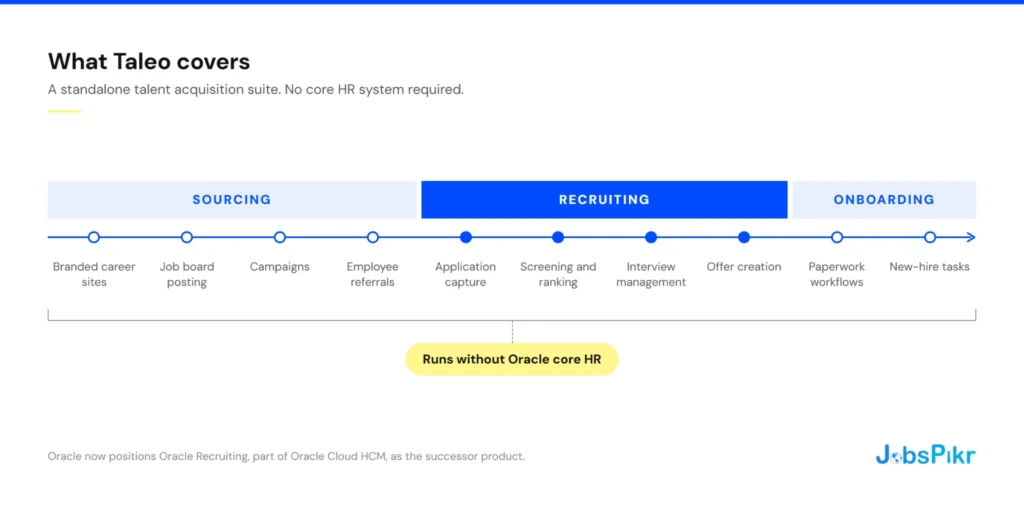
Taleo is an enterprise applicant tracking system (ATS) owned by Oracle. It handles sourcing, recruiting, and onboarding as a standalone talent acquisition suite, meaning an organisation can run it without adopting Oracle’s core HR product. It is used by large employers across banking, healthcare, manufacturing, retail and government. If a careers portal or confirmation email uses a taleo.net address, the hiring process behind it runs on Taleo. Oracle now positions Oracle Recruiting, part of Oracle Cloud HCM, as the successor product and actively supports migration from Taleo.
Who this guide is for
- Candidates trying to work out what a Taleo status means and how long the process takes
- Recruiters and TA operations teams running or inheriting a Taleo instance
- HR technology buyers comparing Taleo against Oracle Recruiting or a newer ATS
- Data and talent intelligence teams who need job posting data out of, or alongside, an ATS
What is Taleo?
Taleo is a cloud-based applicant tracking system. An ATS is the software an employer uses to post a job, collect applications, move candidates through screening and interviews, and record the hire. Taleo does all of that, and extends into sourcing and onboarding.
Oracle acquired Taleo and sells it as a standalone talent acquisition suite. The distinction matters commercially: an organisation can run Taleo for recruiting without replacing its existing core HR system, which is why it spread widely across enterprises that had already standardised on other HR platforms.
Taleo is also one of the older enterprise systems in this category. That shows up in its reputation for configurability on the recruiter side and for a slower, less modern experience on the candidate side compared with newer systems.
Who owns Taleo?
Oracle. Taleo sits within Oracle’s Human Capital Management portfolio.
Is Taleo an ATS?
Yes. Taleo is an applicant tracking system, and specifically an enterprise-grade one built for high-volume, multi-step hiring. Its feature set goes beyond basic application tracking into career site hosting, referral management, offer creation and onboarding, which is why it is often described as a talent acquisition suite rather than simply an ATS.
What does taleo.net mean?
taleo.net is the domain many Taleo-hosted career portals and system emails run on. If the application URL or the confirmation email you received uses taleo.net, the employer is running Taleo. Some newer implementations sit on Oracle Cloud domains instead and look different, but function equivalently.
How Taleo works: the recruiter side
Taleo follows a requisition-driven model. Nothing happens until a role is formally opened in the system, and every candidate is attached to that requisition record.
1. Requisition creation. A hiring manager or HR representative opens a requisition describing the role, approval chain and posting targets. In many organisations an upstream approval form feeds into Taleo automatically rather than being keyed in directly.
2. Sourcing and posting. The requisition publishes to branded career sites and to external job boards. Taleo supports marketing campaigns, automated postings and employee referral features to build talent pools around the requisition.
3. Application capture and screening. Candidates apply through the career site. Taleo captures the application, parses it into a structured candidate record, and applies screening rules so recruiters can filter and rank.
4. Candidate selection. Recruiters move candidates through configurable steps and statuses, schedule interviews, and collaborate with hiring managers and watchers who have view or comment access.
5. Offer and onboarding. Offer creation runs inside the system, and onboarding workflows carry the accepted candidate into their first day with the paperwork completed.
Two design choices shape day-to-day use. The pipeline is highly configurable, so step and status labels differ between employers running the same product. And role-based access separates HR representatives, hiring managers and collaborators, which keeps control with HR while giving managers visibility.
Taleo editions and what each covers
| Edition | Built for | Core capabilities |
| Taleo Enterprise Edition | Large, complex organisations hiring at scale | Configurable hiring workflows · branded career sites and campaigns · candidate screening, interview management, offer creation and onboarding · sourcing and assessment analytics · certified partner ecosystem with LinkedIn integration |
| Taleo Business Edition | Smaller and mid-sized recruiting teams | Multichannel sourcing across job boards, social and referrals · customisable selection processes and recruiter workflows · automation for communications and task assignment · dashboards for candidate quality, time to hire and talent cost · branded onboarding |
| Taleo Business Edition Talent Management | Teams extending past hiring into performance | Goal creation, automated reviews and development plans · workforce insight and succession view · continuous feedback, coaching and mentoring |
Table 1. The three Taleo editions. Enterprise and Business Edition differ in scale and configurability rather than in core purpose.
How Taleo works: the candidate side
For applicants, Taleo is the portal where the application lives and the place a status label appears. The confusion almost always comes from the labels themselves, because employers configure them differently and several sound more encouraging than they are.
What Taleo application statuses actually mean
| Status | What it means |
| Draft | Started but not submitted. Visible only to you; the employer cannot see it. |
| Submitted / Under Consideration | Received and in the queue. It does not confirm that a recruiter has looked at it. |
| Reviewed / Under Review | A recruiter has opened the application. First stage where a human has seen it. |
| In Progress / Active | Generic processing status that can appear at several pipeline points. |
| Phone Interview / HR Screen | An initial call is scheduled or about to be. Watch for a calendar invitation. |
| Hiring Manager Review | Passed the recruiter screen and forwarded on. A genuine positive signal. |
| Interview / Assessment | Scheduled for or completed interviews or a skills test. Often relabelled by the employer. |
| Offer / Verbal Offer | An offer has been extended. Expect recruiter contact on compensation. |
| Hired | Offer accepted and recorded. |
| Rejected / No Longer Under Consideration | Removed from active consideration. Notification timing varies widely by employer. |
Table 2. Common Taleo status labels. Exact wording varies because pipelines are configured per employer.
Why “Under Consideration” is misleading
This is the most misread label in the system. It reads as active evaluation, but in a default configuration it usually means only that the application has been received and is sitting in a queue. The label does not update on its own. It persists until a recruiter manually advances the pipeline stage, which at a high-volume employer may not happen for several weeks.
How long Taleo takes
Taleo is concentrated among large enterprises with formal HR processes, so timelines run longer than at startups or mid-sized firms. Typical ranges are two to six weeks from application to first recruiter contact, one to three weeks from recruiter screen to hiring manager review, and two to six weeks from first interview to offer. End to end, six to fourteen weeks is common.

Can you check your Taleo status directly?
Usually, yes. Most implementations give candidates a login reachable from the employer’s careers page, often labelled “Existing Applicants” or “My Applications”. Sign in with the credentials created during the application and the active submissions are listed there. If the application was submitted as a guest without creating an account, there is no portal access and all updates arrive by email instead.
The 2026 context: Taleo and Oracle Recruiting
The most important thing to understand about Taleo in 2026 is that Oracle is steering customers toward Oracle Recruiting, which sits inside Oracle Cloud HCM. Oracle publishes migration guidance directly on the Taleo product page.
For a buyer, that changes the evaluation. Choosing Taleo today means choosing a mature, widely deployed system whose vendor is pointing at a successor. For a recruiting operations team, it means migration planning is a live question rather than a future one. And for candidates, it explains why two employers running “Taleo” can present very different interfaces, since some have already moved to the newer Oracle experience while others have not.
What Taleo does not tell you
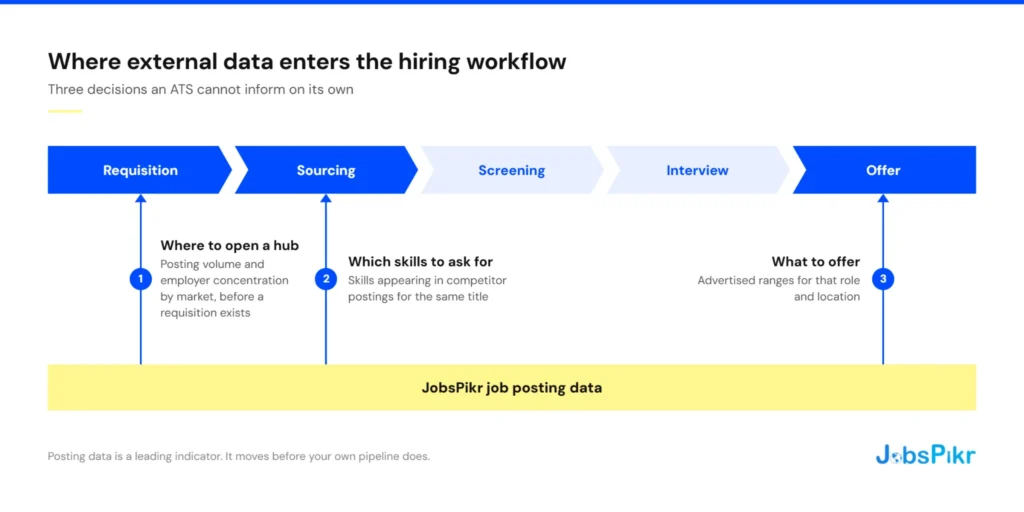
An ATS is a system of record for the candidates who came to you. That is its job, and Taleo does it at scale. What it cannot show you is the market outside your own funnel.
Taleo’s analytics report on sourcing channels, assessments, candidate communications, time to hire and talent cost. Every one of those metrics is internal. None of them answers the questions that decide whether a hiring plan is realistic:
• How many employers are competing for this role in this city right now?
• What salary range are competitors advertising for the same title this quarter?
• Which skills are appearing in postings for this role that were not there a year ago?
• Is the candidate pool in this market expanding or contracting?
A recruiter working only from ATS data can see that time to fill is rising without being able to see why. External job posting data is what closes that gap.

How JobsPikr works alongside an ATS
JobsPikr supplies the external layer that sits beside a system like Taleo. Instead of tracking the candidates who have already applied, it tracks what the wider market is advertising, so recruiting and workforce planning decisions rest on live demand data rather than internal history alone.
Job posting data feeds
Aggregated job posting data across industries, geographies and skills, with titles, skills and locations normalised so roles can be compared consistently. This is what lets a team benchmark their own open requisitions against what competitors are posting for the same positions.
API access for ATS and BI integration
The JobsPikr API delivers that data into existing systems, so market context can appear inside the tools recruiting teams already use rather than in a separate report nobody opens.
Automated collection at scale
For teams that need continuous coverage rather than a one-off pull, the automated job scraper maintains a refreshed feed, which matters because posting activity is a leading indicator and a quarterly snapshot misses the turn.
Labour market reports
Published labour market reports for teams that want the analysis rather than the raw feed.
Three practical use cases
| Scenario | What ATS data shows | What external posting data adds |
| Time to fill is rising on engineering roles | Requisitions are open longer and applications per role are down | Whether competitor postings for the same title have spiked in that metro, and what salary they advertise |
| Deciding where to open a new hub | Nothing — no requisitions exist there yet | Posting volume, employer concentration and skill availability by market before committing |
| A requisition keeps failing at offer stage | Offer declines are logged, with no reason attached | The advertised range competitors offer for that role and location, which is usually the answer |
Table 3. An ATS answers what happened inside your funnel. Posting data answers what is happening outside it.
Frequently asked questions
What is Taleo?
Taleo is an enterprise applicant tracking system owned by Oracle. It covers sourcing, recruiting and onboarding as a standalone talent acquisition suite, which means an organisation can run it without adopting Oracle’s core HR product.
Is Taleo an ATS?
Yes. Taleo is an enterprise-grade applicant tracking system. It extends beyond basic application tracking into career site hosting, referral management, offer creation and onboarding, so it is often described as a talent acquisition suite.
Who owns Taleo?
Oracle. Taleo sits within Oracle’s Human Capital Management portfolio, and Oracle now positions Oracle Recruiting, part of Oracle Cloud HCM, as its successor.
What is Taleo used for?
Employers use Taleo to open job requisitions, publish them to career sites and job boards, collect and screen applications, manage interviews and offers, and run onboarding for new hires.
What is taleo.net?
taleo.net is the domain many Taleo-hosted career portals and system emails use. If an application URL or confirmation email uses it, the employer is running Taleo.
What does “Under Consideration” mean in Taleo?
It usually means the application has been received and is in the review queue, not that a recruiter has actively evaluated it. The label does not update automatically; it stays until a recruiter manually moves the application forward.
How long does Taleo take to process an application?
Two to six weeks is typical before first recruiter contact. Full application-to-offer timelines of six to fourteen weeks are common, because Taleo is concentrated among large enterprises with formal, multi-stage processes.
Can I check my Taleo application status?
Usually. Most implementations provide a candidate login through the employer’s careers page, often labelled “Existing Applicants”. If you applied as a guest without creating an account, updates come by email only.
What is the difference between Taleo and Oracle Recruiting?
Taleo is the older standalone talent acquisition suite. Oracle Recruiting is the newer product inside Oracle Cloud HCM, and Oracle publishes migration guidance for customers moving across. Some employers have already moved, which is why interfaces differ between companies both described as using Taleo.
Can you get job market data out of Taleo?
Taleo reports on your own hiring activity: sourcing channels, time to hire, talent cost. It does not cover the external market. For competitor posting volumes, advertised salaries or skill demand by location, you need an external job posting data source alongside it.
Is Taleo enough on its own?
Taleo does what an enterprise ATS is supposed to do: it holds the requisition, the pipeline and the hire in one configurable system, at a scale that suits very large employers. Candidates find it slow and opaque, which is largely a consequence of configurability and of labels that were never written to be read by applicants.
What it cannot do is show you the market you are hiring into. That is the gap worth closing, because most hiring problems that look internal, roles staying open, offers being declined, pipelines running dry, have external causes that only show up in posting data. See what JobsPikr tracks.